Feedstock
What goes in?Everything upstream of the digester inlet. This is where plant economics are won or lost: yield per tonne is a lab number, and what reaches the gate every day is the real one.
Feedstock
23What you feed it, what that yields, and why securing supply — not choosing a digester — is where most plants fail.
What biogas yields do common feedstocks give?sourced
Indicative ranges per tonne: energy biomass and Napier about 220-290 cubic metres, horticulture waste 140-180, press mud 140-160, kitchen waste and MSW 120-140, cattle dung 100-140, chicken litter 90-120. Treat these as ranges for comparison, not as guarantees for sizing - real yield depends on TS/VS, pretreatment and operation.
Why express yield per kg VS rather than per wet tonne?derived
Because moisture varies enormously between feedstocks - a wet tonne of dung is mostly water. Reporting per kg volatile solids lets you compare feedstocks fairly and size the digester on the organic load it actually has to process.
What is co-digestion, and why do it?sourced
Co-digestion means feeding two or more feedstocks together to balance C:N, dilute inhibitors and stabilise the microbial community. It is usually a yield gain as well as a stability gain: adding just 5% paddy straw to cattle dung raised biogas to about 53.7 L/kg in one study.
Why is feedstock seasonality a problem?sourced
Crop residues arrive in short harvest windows, so a plant that runs year-round has to store months of feedstock through baling or ensiling. Poor storage means dry-matter loss, lost methane potential, and idle capacity in the months between harvests.
What is ensiling, and how is feedstock stored?sourced
Ensiling stores wet biomass such as Napier or straw under anaerobic, acidic conditions so it keeps its digestibility between harvests. Baling and covered storage protect dry residues from rain and rot. Both are how a seasonal crop becomes a year-round feed.
Why is feedstock aggregation the dominant failure mode?sourced
Headline biomass estimates far exceed what actually reaches a plant gate reliably; informal, sporadic supply starves digesters and collapses utilisation. GAIL's Executive Director for CBG puts it bluntly: India cannot build a large CBG industry around sporadic and informal feedstock procurement.
What is spent wash or vinasse, and how is it digested?derived
Spent wash, also called vinasse, is the high-COD liquid effluent from molasses-based distilleries. It is a strong but acidic, sulfate-rich substrate, usually digested in high-rate reactors, and it needs careful pH and sulfide management to stay stable.
How do maize silage and sorghum compare as energy crops?sourced
Maize silage is among the highest-yielding crop substrates, at roughly 160-200 cubic metres per tonne, and it is the backbone of the European biogas fleet. Sorghum offers a similar structure with better drought tolerance. Both compete with food and fodder land use, which is politically sensitive in India.
Why is bagasse a poor standalone AD feedstock?derived
Bagasse is heavily lignified, so it digests poorly, and it is normally burned in the mill's own boiler for captive power - meaning it carries a high opportunity cost as well as low digestibility. It is a co-substrate at most, not a base feed.
How do cotton stalk, wheat straw and sugarcane trash behave in a digester?derived
All three are lignocellulosic residues with high C:N and slow hydrolysis, so they need size reduction and often pretreatment before methane is released at a useful rate. Yields per tonne are moderate; their appeal is abundance and low gate cost, not ease of digestion.
Can banana pseudo-stem and water hyacinth be used?derived
Both are high-moisture, high-cellulose materials that digest reasonably well but carry very low dry-matter content, so large wet tonnages are needed per unit of gas. Water hyacinth also carries harvesting cost. Treat both as local, opportunistic feedstocks rather than a base load.
Can sewage treatment plant sludge be a CBG feedstock?derived
STP sludge is digestible but comparatively low-yielding per tonne, and it carries pathogen and heavy-metal considerations that affect what you can legally do with the digestate. It is more often a co-substrate or a municipal solution than a standalone CBG base.
What Napier yield per acre is realistic, and why do claims vary so much?sourced
Reported Napier biomass ranges from roughly 130 tonnes per acre per year on poorly managed land to nearly 280 with drip irrigation and disciplined fertigation, with Super Napier brochures claiming 350-400. One well-managed interior Andhra farm reached close to 280 while a farm 40 km away on similar soil but saline borewell water struggled past 130. Require location-specific, multi-season data before believing any figure.
How does Napier cut age change methane yield?sourced
As Napier matures, tonnage rises but lignin climbs and digestibility falls, so methane per tonne declines. The practical window is roughly 70-90 days, at 23-30% dry matter. Cut at 50 days it is mostly water; left past 120 days it is lignin-rich and hard to digest.
What biogas yield does Napier actually give per tonne?sourced
Traditional yields are about 90-110 cubic metres of biogas per tonne, equivalent to roughly 38-46 kg of CBG, with SSS-NIBE reporting a process reaching 150 cubic metres per tonne at 15-20 day HRT. A common rule of thumb is that about 20 tonnes of Napier make one tonne of Bio-CNG.
How much land and water does a Napier-fed plant need?sourced
Vendor sizing suggests roughly 500 acres of Napier to feed a 10 TPD Bio-CNG plant, about 120 tonnes a day at around 33% solids. Napier is water-hungry despite its drought tolerance, so water availability must be checked against local supply before the land is committed - and that land is leased, not owned.
Why is ensiling Napier important, and what does it change?sourced
Ensiling preserves Napier for year-round feeding and can improve biogas yield, but the methane potential of a pile changes with silage age - a 30-day pile reads differently from a 45-day one. Farmers often skip silage on cost or risk grounds, which is exactly how a plant ends up with a seasonal supply and an annual target.
Which characterisation tests define a feedstock, and why run them in-house?sourced
The core set is TS, VS, COD, lignin content and a BMP assay, which together predict achievable methane far better than a supplier's brochure. Running low-cost tests in-house across several silage ages - not one sample - is what makes plant design match the feedstock you will actually have.
What does feedstock aggregation logistics actually involve?derived
Baling and collection, a collection radius that keeps haulage economic, and a per-tonne haulage cost that rises with distance. Past a certain radius transport eats the margin. A bankable radius with firm contracts matters more to output than nameplate capacity does.
How large should the feedstock collection radius be?derived
There is no universal figure - the economic radius is set by bulk density, moisture and haulage rate. Wet, low-density biomass such as fresh Napier or water hyacinth travels economically for far shorter distances than baled straw does. The supply calendar exists to expose when radius and seasonality break supply together.
What are typical storage losses and contamination risks?derived
Open storage of wet biomass loses dry matter and methane potential to aerobic decay, and contamination with soil, grit or plastics abrades equipment while diluting gas yield. Covered storage, ensiling and clean handling protect both the yield and the machinery.
How should farmer feedstock contracts be structured?sourced
Specify price, quantity, quality - moisture and age window - and a delivery schedule that matches the plant's supply calendar, with penalties tied to feedstock that is realistically deliverable. Price discovery for energy crops is weak, so anchor the price to multi-season, location-specific data rather than a brochure.
Why is co-digestion of Napier usually better than mono-digestion?sourced
Laboratory and field studies repeatedly show Napier co-digested with cattle dung or food waste yields more and runs more stably than Napier alone, because the co-substrate balances C:N and buffers pH. Mono-digestion of a single lignocellulosic crop is operationally fragile.
Pretreatment & handling
12Chopping, grinding, ensiling and storing: everything that happens between the field and the digester inlet.
Hammer mill, chopper or extruder - what is the difference?sourced
A chaff cutter or chopper cuts coarsely; a hammer mill grinds finer, typically to 1-5 cm for straw; twin-screw extruders and macerators additionally rupture fibre and pump the slurry. Finer size costs more energy, so this is a yield-versus-parasitic-load trade, not a straight upgrade.
Wet or dry AD - what is the difference?sourced
Wet digestion runs at roughly 4-8% total solids as a pumpable slurry; dry digestion runs at about 15-40% TS. Dry and high-load reactors suit high-solids biomass, use less water and take a smaller footprint, but they need different handling equipment throughout.
CSTR, plug-flow or dry batch - which reactor?sourced
A continuously stirred tank reactor is the general-purpose workhorse for slurries; plug-flow suits higher-solids feed and can reach higher loading rates, with dry plug-flow reactors claiming OLR up to about 11 kg VS per cubic metre per day; dry batch or garage-type suits stackable solids. The choice follows feedstock TS and yield target, not preference.
Why heat and mix a digester, and how is it done?sourced
Heating holds the mesophilic window near 35-40 degrees C, usually with external heat exchangers or in-tank coils fed by a boiler burning a slice of the biogas - a heat demand on the order of 0.3 kWh per cubic metre of biogas. Mixing keeps microbes in contact with feed and prevents scum, settling and dead zones. Both draw parasitic energy.
How does an iron sponge remove H2S?sourced
Iron oxide on a wood-chip or pellet carrier reacts with hydrogen sulphide to form iron sulphide and water, exceeding 99.9% removal when properly sized - at ambient temperature and with no electricity. The media saturates and must be replaced or regenerated, and excess water has to be drained or the bed floods.
When is activated carbon used for H2S?sourced
Activated carbon adsorbs hydrogen sulphide - often iron-impregnated for higher capacity - and is valued for simplicity and very low residual levels, usually as a polishing step after bulk removal. Like an iron sponge it saturates, so it needs periodic replacement or regeneration.
What is biological desulphurisation and air dosing?sourced
Sulfur-oxidising bacteria convert H2S to elemental sulfur or sulfate, either by dosing a small amount of air into the digester headspace or in a separate biotrickling filter - commercial trickling filters report over 94% removal on average. Air dosing must be tightly controlled: too much dilutes the methane and can create an explosive mixture.
What are the main mechanical and advanced pretreatment options?sourced
Hammer mills, choppers and extruders reduce size mechanically, with twin-screw extrusion additionally shearing and defibrating. Thermal hydrolysis and steam explosion use heat and pressure to disrupt lignocellulose, while alkali, lime and enzymatic routes act chemically. Thermal-pressure hydrolysis has been shown to raise straw methane yield about 32% over milling alone.
What digester materials and covers are commonly used?derived
Reinforced concrete, glass-fused-to-steel tanks, and HDPE-lined lagoons with floating covers are the common constructions, with mechanical, gas-mix or pump-recirculation agitation. The choice trades capital cost against corrosion resistance and lifespan - and an H2S-laden environment argues for the corrosion-resistant option.
What is condensate handling, and why does it matter?derived
Warm, water-saturated biogas drops liquid condensate as it cools in the pipework, which can block lines and is mildly acidic from dissolved H2S and CO2. Condensate traps and drain points are designed in to remove it continuously rather than at a shutdown.
What role does a flare play?derived
A flare safely burns biogas that cannot be used - during commissioning, upgrading downtime or overproduction - converting methane to CO2 rather than venting a gas with far higher warming potential. An operational flare is a carbon-integrity device as much as a safety one.
What instrumentation is standard on the gas train?sourced
Online analysers for CH4, CO2, O2 and H2S, plus pressure, temperature and flow, feeding a control system that can trip or divert off-spec gas. Reliable H2S measurement in particular lets operators dose scrubbing media to the actual load instead of over- or under-dosing it.
The blocks
Full catalogue, all figures ->12 of the pieces you can put on the canvas belong to this stage. Every figure behind them is the one the simulator runs on, and each card says what the block takes in and what it hands on.
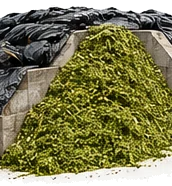
Napier silage
year-roundDedicated elephant grass silage. Balanced C:N and reliable BMP.
SOURCE · MAKES FEEDSTOCK
- Total solids
- 25%
- Volatile solids, of total solids
- 90%
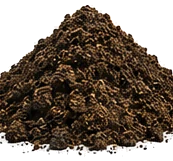
Sugar mill pressmud
seasonalFilter cake from sugar mill juice clarification. Dense, wet, cheap.
SOURCE · MAKES FEEDSTOCK
- Total solids
- 30%
- Volatile solids, of total solids
- 75%
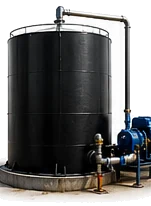
Molasses
year-roundSugar refining residual syrup. Very high BMP and digestibility.
SOURCE · MAKES FEEDSTOCK
- Total solids
- 80%
- Volatile solids, of total solids
- 85%

Paddy straw
seasonalRice harvest residue. Very high TS, wide C:N, slow to digest.
SOURCE · MAKES FEEDSTOCK
- Total solids
- 85%
- Volatile solids, of total solids
- 80%
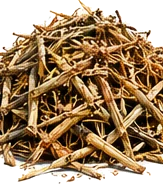
Cane trash
seasonalSugarcane leaves and tops left in the field after harvest.
SOURCE · MAKES FEEDSTOCK
- Total solids
- 70%
- Volatile solids, of total solids
- 85%
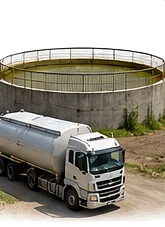
Cattle manure
year-roundDairy or beef cattle slurry. Low TS, low C:N, abundant near dairies.
SOURCE · MAKES FEEDSTOCK
- Total solids
- 12%
- Volatile solids, of total solids
- 80%
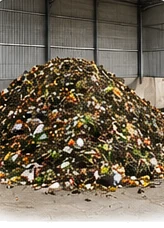
MSW organic fraction
year-roundWet biodegradable fraction of municipal solid waste. Tipping fee eligible.
SOURCE · MAKES FEEDSTOCK
- Total solids
- 30%
- Volatile solids, of total solids
- 75%
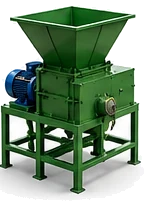
Chops green and soft wet material to a feedable particle size. Enough for napier, trash and segregated wet waste.
TAKES FEEDSTOCK · MAKES FEEDSTOCK
- Specific energy
- 4 kWh/t
- Handling cost
- ₹120/t
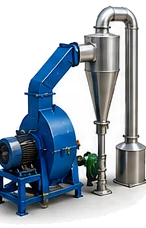
Impact milling for dry lignocellulosic straw. Baled paddy straw cannot be wetted out or pumped until it has been through one.
TAKES FEEDSTOCK · MAKES FEEDSTOCK
- Specific energy
- 25 kWh/t
- Handling cost
- ₹250/t
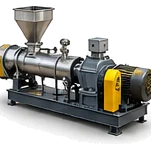
Mechanical pretreatment that shears lignocellulose open. Optional, energy hungry, and its yield uplift is not modelled here.
TAKES FEEDSTOCK · MAKES FEEDSTOCK
- Specific energy
- 45 kWh/t
- Handling cost
- ₹400/t
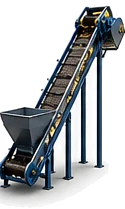
Belts, augers and a feed hopper. Bulk solids do not move themselves, and at plant scale this is a real line item.
TAKES FEEDSTOCK · MAKES FEEDSTOCK
- Specific energy
- 2 kWh/t
- Handling cost
- ₹40/t
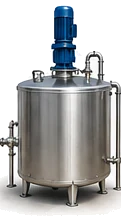
Blends feedstocks, balances C:N, regulates flow into the digester.
TAKES FEEDSTOCK · MAKES SLURRY
- Pre-heat temperature
- 30 °C
Sourcing sits beside these blocks as it is verified — vendors, capacities and indicative lead times, kept separate from the modelled figures and labelled whenever a link is paid. Supply this equipment?
Answers come from this site's reviewed question bank and cite the entry they came from. Press / to focus. Not investment advice.