Market
Who buys it, and does it pay?Offtake, price and the money. Assured offtake removes market risk; it does not remove feedstock risk, and lenders test the second one first.
Market & offtake
21Who buys the gas, at what price, under which agreement, and how it gets to them.
Who buys the gas?sourced
Under SATAT the state oil marketing companies - IndianOil, BPCL and HPCL - buy CBG under long-term agreements and sell it at their retail outlets. CGD companies buy it through GAIL's synchronisation scheme, and industrial users and direct retail are additional routes.
Is there a guaranteed floor price for CBG?sourced
Yes. The original SATAT floor was 46 rupees per kg plus taxes, and under the synchronisation scheme a floor of 770 rupees per MMBTU applies. Pricing is now largely administered or formula-based rather than a single fixed rate, so quote the regime along with the number.
What has the CBG procurement price been?sourced
SATAT set a floor of 46 rupees per kg plus taxes in 2018, not to fall below that through 31 March 2029. From June 2025 pricing was linked to 85% of the average CGD CNG price. GOBARdhan (2026) then introduced an administered price of 2,110 rupees per MMBTU, around 105 rupees per kg. Treat evolving figures as sourced scenario inputs, not guarantees.
How is the CBG procurement price currently set?sourced
Since May 2025 the biogas procurement price is calculated as 85% of the average retail selling price of CNG across GAIL's CGD entities, raised from 80%. MoPNG revised the rate from 1,380 to 1,478 rupees per MMBTU excluding GST for 1 June to 31 October 2025 - roughly 72.8 to 77.4 rupees per kg at 95% methane - with the floor remaining 770 rupees per MMBTU.
What does GOBARdhan set as the administered CBG price and capital aid?sourced
Alongside its 23,731 crore rupee outlay, the 2026 GOBARdhan scheme sets an administered CBG price of 2,110 rupees per MMBTU and capital assistance of up to 2 crore rupees per TPD. That administered price is a material step up from the 1,478 rupees per MMBTU synchronisation rate and changes project economics accordingly.
What transportation charges apply under the synchronisation scheme?sourced
No transport charge applies up to 50 km, since it is built into the base price; 1.5 rupees per kg applies for 50-75 km and 2.5 rupees per kg beyond 75 km, paid by the beneficiary CGD entity. Producers also receive a compression charge - 8 rupees per kg to a retail outlet, 2 rupees per kg for pipeline injection.
What are the Uniform Base Price and the Tripartite Agreement?sourced
GAIL is mandated to supply biogas and CBG co-mingled with domestic gas at a uniform base price across all CGD entities, under a tripartite agreement between the producer, GAIL and the CGD entity. This is the mechanism that lets scattered producers sell into the national network at a single reference price.
What is the CBG-CGD synchronisation scheme?sourced
GAIL buys biogas or CBG from producers and supplies it co-mingled with domestic gas at a uniform base price to CGD entities. The producer signs an agreement with GAIL plus a tripartite agreement with the local CGD entity, and no OMC letter of intent is required.
What does the SATAT commercial agreement look like?sourced
OMCs sign a long-term commercial agreement - commonly cited as 15 years - and SATAT carries no take-or-pay clause. CBG must be delivered at 250 bar in cascades to the retail outlet, generally within a defined radius, and quality faults trace to whichever party's equipment caused them.
How long are the offtake agreements, and can prices be revised?sourced
Agreements are long-term - cited variously as five years with extension, or up to 15 years under some structures - with periodic price revision under the synchronisation formula. The minimum procurement price cannot fall below the notified floor.
How is CBG transported?sourced
By cascade - high-pressure cylinder trucks - to retail outlets, or injected into the CGD pipeline where connectivity exists. Pipeline connection lowers logistics cost substantially, but few plants are yet connected, so most sites are trucking.
What is the SATAT LOI process, step by step?sourced
A developer responds to an OMC Expression of Interest, submits project details, and on selection receives a Letter of Intent, which is then the basis for site finalisation, financing and the commercial agreement. As of July 2025 the SATAT portal recorded 108 commissioned plants against 1,094 active LOIs - a gap worth understanding before assuming an LOI is a plant.
What is the CBG Blending Obligation, and what is its trajectory?mandate ≠ capacity
The CBO, approved by the National Biofuels Coordination Committee, requires CGD entities to blend CBG into CNG for transport and PNG for domestic use: 1% in FY2025-26, 3% in FY2026-27, 4% in FY2027-28 and 5% from FY2028-29. It creates demand; it is not itself installed capacity.
Was the first-year blending target met, and does that mean the capacity exists?mandate ≠ capacity
In FY2025-26 CBG sales into the CNG transport and PNG domestic segments reached 1.05% against the 1% target, per the Petroleum Minister's written reply of 6 August 2026. But the CBO is an obligation on CGD entities to blend, not proof that enough CBG capacity has been built - India had roughly 217 commissioned plants against a 5,000 target at the same date.
Is CBG offtake take-or-pay?sourced
No. Offtake is assured under SATAT and the synchronisation scheme but is not a classic take-or-pay, and because anaerobic digestion cannot be ramped on and off, mismatch risk sits partly with the producer. Financiers therefore weigh feedstock and O&M capability alongside the offtake contract rather than treating the contract as sufficient.
Who are the major CBG developers, and at what scale?projection
Reliance laid the foundation on 2 April 2025 for the first of a planned 500 plants - Kanigiri in Andhra Pradesh, 475 acres, 139 crore rupees, 100 TPD - within a 65,000 crore rupee state programme. Adani Total Gas runs Barsana at 600 TPD feedstock; GPS Renewables builds EPC at scale with IOC and BPCL joint ventures; EverEnviro operates an Indore MSW plant of about 15 TPD. Most of the large figures are planned capacity, not operational.
Who serves the Kalaburagi geographical area?needs verification
The Kalaburagi-Vijayapura geographical area is served by AG&P Pratham / THINK Gas, holding 25-year PNGRB authorisation across several southern states. Kalaburagi has no trunk gas pipeline, so CBG there is cascade and retail oriented rather than injection oriented.
What industrial thermal customers exist beyond transport?sourced
Industrial users buy CBG or biomethane to displace LPG, furnace oil or coal for process heat, priced against rupees-per-MMBTU parity with those fuels. In districts with coal, FO or LPG-based industry and no pipeline, that thermal demand can be the most direct offtake route available.
Can producers sell directly to fleets or through their own outlets?sourced
Yes, and many prefer to - it captures more value and avoids the losses and taxation friction of pipeline injection. Multiple stakeholders report that on-ground synchronisation remains limited, so direct sales still dominate in practice.
What does the blending mandate mean for investors?mandate ≠ capacity
It converts voluntary demand into a legal obligation on CGD entities, which improves offtake certainty - but the volumes are consumption-linked targets, not a guarantee that supply exists. Petroleum Minister Hardeep Singh Puri stated the CBO would encourage investment of around 37,500 crore rupees and facilitate 750 CBG projects by 2028-29, which is a projection rather than a commitment.
How should a developer forecast demand for a specific site?derived
Anchor the forecast to the local CGD entity's actual CNG and PNG volume times the CBO percentage, plus any industrial thermal demand nearby - not to national totals. As an illustration, a 10 TPD plant over 330 days at the administered price implies roughly 33 crore rupees of annual CBG revenue.
Finance
17Capex, the revenue stack, IRR and DSCR, and what a lender actually tests.
Is a CBG plant profitable?sourced
It can be, with commonly cited returns of roughly 14-20% IRR and a 4-6 year payback - but only where feedstock is secured cheaply, uptime reaches 85-90% and the digestate is monetised. Assured OMC offtake removes market risk; it does not remove execution risk, and the returns are execution-dependent.
Who finances CBG plants?sourced
Promoter equity plus bank and NBFC debt - Bank of Baroda has a CBG line for plants of 2 TPD and above, and NABARD refinances rural projects - alongside MNRE capital subsidy and state incentives. CBG carries RBI Priority Sector Lending status, and GOBARdhan (2026) adds a credit guarantee covering up to 85% of eligible MSME loans.
What is a typical capex breakdown for a 5 TPD plant?sourced
Illustratively: feedstock pre-processing about 1.5 crore rupees, digester about 5 crore, upgrading about 4.5 crore, compression and cascade about 3 crore, civil and utilities about 2 crore, instrumentation and SCADA about 1 crore - totalling roughly 20-30 crore. Upgrading plus compression alone is 20-25% of capex.
What is the typical financing structure?sourced
Commonly around 50-60% debt and 20-30% equity with the balance from subsidy, where Central Financial Assistance of up to 10 crore rupees and state subsidies of 1-3 crore reduce both the equity and the debt requirement. Documentation quality is what drives when the subsidy actually arrives.
What are the key sensitivity drivers of IRR?sourced
Feedstock cost and availability, plant utilisation, methane recovery and slip, the CBG price, and FOM realisation. Feedstock is usually the largest single cost and the biggest swing factor, and small changes in utilisation move IRR more than most equipment choices do.
What IRR and DSCR are typical?sourced
Advisory sources cite roughly 14-22% post-tax IRR and DSCR around 1.4-1.7x for a typical 5-10 TPD biomass plant, but returns vary sharply by feedstock: paddy straw around 7-12%, Napier, press mud and poultry 12-20%, spent wash and maize reaching 20-30%. The feedstock decision is the return decision.
How does feedstock choice change project cost?sourced
For a 20 TPD plant, indicative project cost was about 11 crore rupees on press mud, poultry or dung; about 12 crore on Napier; about 14 crore on paddy straw; and about 28 crore on segregated MSW. Handling-heavy feedstocks cost more to build for as well as more to run.
Why is subsidy timing a real risk?sourced
CFA and state subsidies are disbursed against milestones and complete documentation, so a paperwork or verification delay stretches payback and strains working capital at exactly the wrong moment. Incomplete applications are the most commonly cited cause of delay.
What is the levelised revenue stack?sourced
CBG - up to 2,110 rupees per MMBTU administered under GOBARdhan, against 1,478 under the synchronisation scheme - plus FOM, LFOM and PROM with 1,500 rupees per tonne of MDA behind them, plus optional biogenic CO2 and contingent carbon. Costs are dominated by feedstock and parasitic power. A defensible model treats CBG plus FOM as the core and CO2 and carbon as upside.
How do land-lease and FPO or cooperative models work?derived
Land for the plant and for any energy-crop cultivation is leased, never owned, and farmer producer organisations or cooperatives can aggregate feedstock and share revenue. These structures spread feedstock risk and align farmer incentives with the plant's uptime rather than against it.
What tax, depreciation and GST-credit factors apply?needs verification
Projects can use accelerated depreciation and input GST credits, and Budget 2026-27 exempted central excise on the CBG portion of blended CNG, improving CGD willingness to pay the full rate. MSME status can unlock further benefits. Exact rates should be confirmed with a tax adviser rather than taken from a summary.
What does a DPR need to be bankable?sourced
Realistic, location-specific feedstock data and contracts; conservative yield and recovery assumptions; a full approvals map; sensitivity analysis; and vendor performance guarantees. Lenders discount optimistic Napier yields and overstated utilisation, so a DPR built on brochure figures is discounted before it is read.
What is the Reliance Kanigiri benchmark?sourced
Per Business Standard (2 April 2025), Reliance New Energy's first CBG plant at Kanigiri, Andhra Pradesh - 100 tonnes, 475 acres, Napier-based - is being established with an investment of 139 crore rupees, and is the first of a planned 500 plants totalling 65,000 crore. It is a captive-feedstock, large-integrated model, not a template for a standalone 5 TPD plant.
Which business-model choices matter most?sourced
Retail-outlet versus pipeline-injection offtake; captive versus aggregated feedstock; and whether digestate and CO2 are monetised at all. Small retail-model plants can cost roughly double the pipeline-injection model for the same capacity, so the offtake decision is a capex decision too.
What newer finance instruments are emerging?sourced
Recent deals show structured debt - an 836 crore rupee facility for nine plants under the IOC-GPS Renewables joint venture - and mezzanine funding of 50 crore from an asset manager, alongside green bonds, blended finance and viability-gap-style support. The capital base is widening beyond plain bank debt.
What replication and consolidation dynamics should investors expect?projection
Large players - Reliance, Adani Total Gas, GPS Renewables, EverEnviro, and IOC and IGL joint ventures - are building multi-plant portfolios, which favours standardised replicable designs and creates eventual consolidation potential. Portfolio counts are planned rather than operational, so read them as pipeline, not fleet.
Why should working capital and EPC warranties be sized carefully?derived
Feedstock is often paid for well ahead of CBG and FOM receipts, and subsidy timing is uncertain, so undersized working capital distresses otherwise viable plants. On the contract side, insist on guaranteed methane recovery, guaranteed specific power consumption and a guaranteed outlet specification, each with a test protocol and a penalty attached.
The blocks
Full catalogue, all figures ->2 of the pieces you can put on the canvas belong to this stage. Every figure behind them is the one the simulator runs on, and each card says what the block takes in and what it hands on.
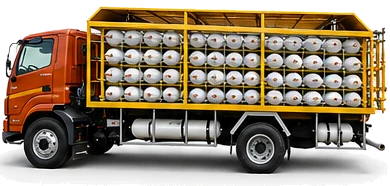
Tanker pickup by an oil marketing company under the SATAT scheme.
TAKES CBG · SINK
- Default gate price
- ₹105/kg
- Transport to the buyer
- ₹3/kg
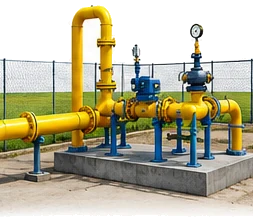
Direct injection into a city gas distribution pipeline.
TAKES CBG · SINK
- Default gate price
- ₹110/kg
- Transport to the buyer
- ₹1/kg
Sourcing sits beside these blocks as it is verified — vendors, capacities and indicative lead times, kept separate from the modelled figures and labelled whenever a link is paid. Supply this equipment?
Answers come from this site's reviewed question bank and cite the entry they came from. Press / to focus. Not investment advice.