Facility
What happens inside?The biology, the vessel and the routine. A digester is a culture of microbes with a loading limit, not a tank that converts tonnes to gas on demand.
Anaerobic digestion
30The biology the whole plant rests on — the four stages, the operating window, and what tips it over.
What is biogas?sourced
Biogas is the gas produced when microbes break down organic matter without oxygen, a process called anaerobic digestion. It is mainly methane and carbon dioxide, with traces of hydrogen sulphide and water vapour. Raw biogas typically contains 50-70% methane.
What is raw biogas?sourced
Raw biogas is the untreated gas straight from the digester - roughly 50-70% methane and 30-45% carbon dioxide, plus trace hydrogen sulphide and water vapour. It must be cleaned and upgraded before it can be sold as CBG.
What is methane?sourced
Methane (CH4) is the energy-carrying, combustible part of biogas, and the same molecule that makes up most of natural gas. The more methane a gas contains, the higher its fuel value.
What is anaerobic digestion?sourced
It is the natural, oxygen-free breakdown of organic matter by microbes, producing biogas and a nutrient-rich residue called digestate. It happens inside a sealed tank called a digester.
What is the C:N ratio?sourced
The carbon-to-nitrogen ratio compares how much carbon a feedstock carries relative to nitrogen, and it controls how well the microbes work. The generally accepted optimum for anaerobic digestion is about 20:1 to 30:1. Too much carbon and the culture runs slow; too much nitrogen and it poisons itself with ammonia.
How much energy is in a cubic metre of biogas?sourced
Raw biogas at 55-65% methane carries about 20-23 MJ per cubic metre, because only the methane fraction holds energy. Pure methane is about 35.8 MJ per cubic metre, and one cubic metre of biogas is roughly equivalent to 0.5-0.6 litres of diesel.
Why does raising the methane percentage raise the energy value?derived
Carbon dioxide, nitrogen and water vapour in biogas are inert and carry no combustion energy, so calorific value scales almost linearly with methane content. Upgrading from about 60% to over 90% methane concentrates the energy per cubic metre, which is what makes CBG saleable as a vehicle fuel rather than a boiler gas.
What is an inoculum, and why does a new digester need one?derived
An inoculum is a starter culture of active anaerobic microbes, usually digestate or slurry from a running digester, or cattle dung. Without seeding, a new digester can take months to establish stable methanogenesis, so the inoculum is what shortens the start-up lag.
What is foaming in a digester, and why does it matter?derived
Foaming is a stable layer of gas-filled bubbles on the digester surface, usually triggered by overloading, or by feed rich in surfactants, proteins or fats. It can block gas offtake, carry slurry into the gas lines and force an unplanned shutdown.
What are the four stages of anaerobic digestion?sourced
Hydrolysis breaks complex polymers into monomers; acidogenesis turns those into volatile fatty acids; acetogenesis converts them to acetic acid, hydrogen and CO2; methanogenesis produces methane. For fibrous feedstocks hydrolysis is usually the rate-limiting step, which is why pretreatment matters so much for straw and grass.
What are VS and TS?sourced
Total solids (TS) is the dry mass left after water is removed. Volatile solids (VS) is the organic, digestible fraction of TS - the part that actually converts to biogas. Yield is best expressed per kg VS, because a wet tonne of dung is mostly water.
What is BMP?sourced
Biochemical Methane Potential is a lab batch test measuring the maximum methane a feedstock can yield per kg VS under ideal conditions. It sets a theoretical ceiling; real plants achieve only a fraction of it, so sizing a plant off BMP alone will oversize the gas and undersize the disappointment.
What is HRT?sourced
Hydraulic Retention Time is the average time feedstock stays in the digester - digester volume divided by the daily feed volume. Single-stage mesophilic systems typically run 15-40 days. Cut it too short and material leaves before the microbes have finished with it.
What is OLR?sourced
Organic Loading Rate is how much organic matter (kg VS) is fed per cubic metre of digester per day. Overloading is the classic way to kill a digester: acid builds up faster than the methanogens can consume it, pH falls, and gas production collapses for weeks.
What temperature regimes are used?sourced
Mesophilic runs at about 35-37 degrees C and is more stable; thermophilic runs at about 50-57 degrees C, is faster and kills pathogens better, but is more sensitive to upset. Daily temperature drift should be kept small - on the order of 0.6 degrees C per day.
What pH, VFA and alkalinity ranges are healthy?sourced
Bulk digester pH should sit around 6.5-8, and methanogens prefer 6.5-8.2. The earliest warning of instability is not pH itself but a rising ratio of volatile fatty acids to alkalinity - pH only moves once the buffer is already spent.
What is ammonia inhibition?sourced
High-nitrogen feedstocks release ammonia, and free ammonia inhibits methanogens. Inhibition generally begins around 1,500-3,000 mg/L total ammonia nitrogen in unacclimated systems, with free ammonia near 150-200 mg/L marking serious onset. Acclimated cultures tolerate substantially more, above 5,000 mg/L.
Why is H2S a problem?sourced
Hydrogen sulphide is corrosive and toxic. It damages engines, compressors and pipelines, and must be removed before upgrading. IS 16087:2016 caps total sulphur, including H2S, at 20 mg per cubic metre in finished CBG.
What is the Buswell equation, and what does it predict?sourced
The Symons-Buswell stoichiometric equation estimates theoretical methane and CO2 yield for an organic compound from its elemental composition, assuming complete biodegradation. It gives an upper bound - a theoretical BMP - and real BMP is lower, so operators apply a biodegradability factor.
What is the F/M ratio, and how does it differ from OLR?derived
The food-to-microorganism ratio expresses feed mass (as COD or VS) per unit of active biomass; OLR is feed per unit of reactor volume per day. A high F/M can overload the methanogens and cause volatile fatty acids to accumulate even when OLR looks acceptable on paper.
Which trace elements must be dosed, and at roughly what levels?sourced
Iron, nickel, cobalt, selenium, molybdenum and tungsten are enzyme cofactors for methanogens, and deficiency shows up as VFA accumulation and eventual failure. A 2025 review fitted effective ranges of roughly 0.56-1.67 mg/g VS iron, 0.01-0.1 mg/g VS cobalt and 0.04-0.5 mg/g VS nickel, with efficiency falling once doses run above those ranges.
What is LCFA inhibition?derived
Long-chain fatty acids released from fats, oils and grease adsorb onto microbial cell walls and inhibit methanogenesis, causing a lag or a stall even though the fat itself is energy-rich. Fat-rich feeds are therefore added carefully and usually co-digested at controlled ratios.
How does H2S form in a digester, and how is it controlled?sourced
Sulfate-reducing bacteria convert sulfur in the feed to hydrogen sulfide. It is controlled either at source - dosing a little air or oxygen into the headspace, or adding iron salts - or downstream with an iron sponge, activated carbon or a biological scrubber.
What is two-stage (phased) digestion?derived
Two-stage digestion separates hydrolysis and acidogenesis in a first reactor from methanogenesis in a second, letting each microbial group work at its own optimum pH and retention time. It can raise yield and stability for some feedstocks, at the cost of extra capital and control complexity.
What is psychrophilic digestion, and why is it rare commercially?derived
Psychrophilic digestion runs below about 20 degrees C on cold-tolerant microbes. Rates are slow, so it needs long retention times and large reactor volumes. Most commercial CBG plants run mesophilic because it balances reaction rate against stability.
How is biogas stored on site before upgrading?derived
Low-pressure raw biogas is buffered in double-membrane gas holders - an inner gas membrane under an outer weather membrane held taut by an air blower. These absorb short-term mismatches between production and demand; they are buffers, not high-pressure storage.
Why does the C:N ratio matter to an investor?derived
It drives both biogas yield and digester stability, so it decides how much sellable gas a feedstock mix produces and how often the plant trips. High-carbon feedstocks such as paddy straw are usually co-digested with high-nitrogen dung to reach the 20-30:1 window - and that is a procurement commitment, not a setting on a control panel.
What single biological failure most often destroys plant economics?derived
Acidification from overloading or a C:N imbalance, which stalls methanogenesis and cuts gas output for weeks. Conservative loading and co-digestion are cheap insurance against a failure whose recovery time is measured in lost revenue.
Why should investors treat methane's global warming potential as a two-edged number?sourced
Methane's GWP is about 28-30 over 100 years and around 80 over 20 years, so avoided methane is the core climate value of CBG. The same potency means on-site leakage sharply erodes the net benefit, which is why diligence should require leak detection and a specified maximum methane slip rather than taking the carbon claim on trust.
What is degassing of digestate, and why does it matter to the carbon case?sourced
Fresh digestate leaving the main digester still holds residual biogas potential. Stored open, it emits methane and undermines the emissions balance; a covered post-digestion tank captures that residual gas, adding yield and protecting the carbon claim at the same time.
Building a plant
15Land, approvals, PESO, the DPR, and what actually sits on the critical path.
How do you set up a biogas or CBG plant in India?sourced
Secure a reliable feedstock supply first, then pick a site with land, water and a way to move gas out; choose digester and upgrading technology; get an offtake letter of intent from an OMC or a GAIL synchronisation agreement; clear the pollution board, PESO, factory and land approvals; then build and commission. Feedstock security is the make-or-break step, and it comes before the site, not after it.
What are the first steps, concretely?sourced
Confirm feedstock availability with a long supply horizon, identify a site - typically 5-10 acres for a 5-10 TPD plant - and engage an oil marketing company with an Expression of Interest to secure a Letter of Intent. The LOI from IOCL, BPCL, HPCL, GAIL or IGL is the gateway to bankability.
Which pollution-control category does a CBG plant fall under?sourced
Pollution control boards generally categorise CBG plants as White - the least polluting class - which simplifies Consent to Establish and Consent to Operate. Typical CBG scales also avoid full Environmental Clearance under the EIA notification. PESO remains the safety-critical approval regardless.
What is the approvals-to-commissioning critical path?sourced
Broadly: secure the LOI, obtain Consent to Establish plus land and panchayat NOCs, run detailed engineering and construction, clear PESO and fire approvals, obtain Consent to Operate, then commission. Approvals run in parallel with engineering, and developers are repeatedly advised to map them before ordering equipment rather than after.
Why is PESO licensing central, and what does it cover?sourced
PESO, under the SMPV rules, licenses high-pressure storage and handling of compressed gas at 250 bar - which makes it the most safety-critical regulatory dimension of a CBG plant. It rewards early specialist engagement at the engineering stage, because a late PESO submission moves the commissioning date directly.
What approvals and licences are needed?sourced
Typically: State Pollution Control Board Consent to Establish and Consent to Operate; a PESO licence for high-pressure storage and dispensing; factory or establishment registration under the OSH Code 2020; fire NOC under NBC 2016; land-use conversion where needed; hazardous-waste authorisation where applicable; GOBARdhan registration; and an OMC or GAIL offtake agreement. The exact stack varies by state, capacity and location.
What is GOBARdhan portal registration, and does it replace other approvals?sourced
Registration on the GOBARdhan unified portal records the project - location, capacity, feedstock - and is how the national plant count is compiled. It is a registration step, not a licence: it substitutes for none of the pollution consents, PESO or land approvals.
What does a Detailed Project Report contain?sourced
A bankable DPR covers feedstock assessment, technology selection, mass and energy balance, capex and opex, statutory approvals, financing structure and sensitivity analysis. Both lenders and subsidy disbursement hinge on it, so a thin DPR delays money as well as approval.
What are HAZOP and QRA, and when are they done?derived
A hazard and operability study and a quantitative risk assessment systematically identify process hazards and quantify the resulting risk. Given flammable gas and 250-bar storage they belong at the engineering stage, where they inform safety setbacks, fire design and PESO compliance rather than documenting a design already frozen.
How much land and water does a plant need?sourced
About one acre per TPD is a common planning figure - 5-10 acres for a 5-10 TPD plant - plus water for scrubbing and slurry make-up, with water scrubbing alone drawing several cubic metres an hour. Captive energy-crop models need far more: Reliance's 100 TPD Kanigiri site spans 475 acres including the Napier land.
Why do land conversion and the panchayat NOC matter?derived
Agricultural land usually needs conversion to non-agricultural use, and a panchayat or local NOC is commonly required - both of which lengthen the timeline if left late. Because the land is leased rather than owned, the lease terms also have to permit the intended industrial use.
What is the GST and excise position on CBG?needs verification
CBG historically faced a double-taxation problem at the blending point. Budget 2026-27 exempted central excise duty on the biogas or CBG portion of blended CNG, removing a barrier that had made CGD entities reluctant to pay the full rate. GST still applies and should be modelled explicitly in the DPR.
What insurance and O&M contract structures are typical?derived
Plants carry erection and construction cover during build and operational asset cover afterwards, and are run under an O&M contract - self-run or EPC-linked - that defines uptime obligations and maintenance responsibility. Clear O&M accountability is what protects the utilisation the returns depend on.
What capex per TPD should a developer budget?sourced
Benchmarks vary by feedstock and offtake model. A 5 TPD plant commonly clusters around 20-30 crore rupees, or roughly 2-3 crore per TPD; the Standing Committee on Petroleum and Natural Gas cited 25-80 crore for a 100 TPD multi-feed plant; and GOBARdhan (2026) offers capital assistance up to 2 crore rupees per TPD against that.
How long does it take from LOI to commissioning, and should you use an EPC?sourced
Approvals processing alone runs about 60-90 days with complete documentation, but the full LOI-to-commissioning path typically takes one to two years once land, feedstock contracting and construction are counted; incomplete paperwork is the most common delay. An EPC route transfers execution and performance risk to a vendor through guarantees and suits first-time developers; self-build can cost less for experienced ones. Either way, insist on performance guarantees tied to realistic feedstock.
Operations
20Running it: uptime, parasitic load, maintenance, and the failure modes that idle a plant.
How efficient are biogas plants?sourced
Efficiency depends far more on feedstock and operation than on technology, and many Indian plants run below design capacity mainly because of feedstock supply. Real output is a fraction of the lab BMP potential, so a plant quoted at its BMP is quoted at a number it will never see.
What does a plant operator do in a typical day?derived
Feed the digester to schedule, check temperature, pH and gas quality, log flows and pressures, and inspect the scrubbers, compressors and safety systems. Consistent daily logging is what lets a problem be caught as a trend rather than as a shutdown.
How is raw biogas volume converted to kg of CBG?sourced
A 5 TPD-class plant making about 12,000 cubic metres a day of raw biogas at 60% methane holds roughly 7,200 cubic metres of methane, which after upgrading and compression yields about 4,800-5,000 kg a day of saleable CBG. Volume falls through upgrading because CO2 and H2S are removed; energy density rises.
What KPIs describe plant health?sourced
Capacity utilisation - uptime times load - specific gas yield in cubic metres per kg VS, methane content, methane slip, parasitic energy load, and digester stability read through VFA to alkalinity and pH. Bankable models assume high uptime, so utilisation is the KPI the financial model is most sensitive to.
What uptime do healthy plants target?sourced
Investor guidance ties acceptable returns to roughly 85-90% plant uptime. Below that, unit economics deteriorate quickly, because the capex is fixed and the revenue is not.
What is parasitic load?derived
It is the plant's own energy consumption - heating, mixing, pumping, upgrading and compression - which reduces net saleable output and shows up directly in operating cost. The upgrading technology chosen sets much of it: amine's thermal demand and cryogenic power draw are very different propositions from a membrane skid.
What are the common failure modes?sourced
Feedstock aggregation shortfalls dominate, followed by digester acidification from overloading, H2S corrosion, upgrading downtime, and evacuation and logistics gaps. Only a small share of commissioned plants are pipeline-connected - PNGRB noted just 17 of 207 - so trucking capacity is a live constraint on many sites.
What does a mass and water balance track?derived
Feedstock in, water added, biogas and digestate out, and losses - so that inputs and outputs reconcile and an operator can spot a leak, under-feeding or off-spec running. A closed balance is also the prerequisite for any carbon MRV claim.
What maintenance does the compressor need?sourced
Scheduled valve, seal and lubrication servicing plus intercooler and moisture checks, because it runs at high pressure and is a common failure point. Preventive maintenance here directly protects the uptime the economics depend on.
How often are upgrading membranes or scrubbing media replaced?sourced
It depends on inlet-gas cleanliness. Iron sponge and activated carbon saturate and are replaced on breakthrough; membranes degrade with age, temperature excursions and pressure swings. Ask an operating plant about actual replacement intervals rather than trusting commissioning-day figures.
How is foaming controlled during operation?derived
Reduce organic loading, adjust the feed mix to limit surfactant, protein and fat spikes, improve mixing, and dose antifoam where needed. Early detection through level and pressure monitoring is what prevents carryover into the gas lines and an unplanned stop.
How are monsoon operations and wet feedstock handled?sourced
The monsoon raises feedstock moisture, complicates storage and haulage, and dilutes yield, so covered storage, drainage and an ensiled buffer stock are what keep feeding steady. When evaluating an existing plant, ask specifically about monsoon performance - annual averages hide it.
How is a plant restarted after a shutdown or power outage?sourced
Purge and re-establish gas flow safely, bring the digester back to temperature, then restore feeding gradually so the microbes are not shocked. Anaerobic digestion cannot be switched on and off quickly, which is why backup power for critical loads is worth its cost.
Why is temperature control critical?derived
Mesophilic digestion has to be held near 35-40 degrees C; swings slow the microbes and cut yield, so heat exchangers or coils plus insulation hold it steady. Loss of heating is a leading cause of quiet, gradual yield decline that shows up in the monthly numbers rather than as an alarm.
What role do SCADA, IoT and telemetry play?sourced
They continuously monitor temperature, pressure, flow and gas quality, enabling alarms, trend analysis and benchmarking against design - and SCADA or remote monitoring is mandated for some MNRE-supported bioenergy projects. Good instrumentation is what turns reactive firefighting into predictive operation.
What spares and consumables must be stocked?derived
Compressor valves and seals, scrubbing media and membranes, pumps and instrumentation, plus consumables such as trace-element dosing and antifoam. A stock-out of one critical spare can idle the entire plant, which makes the inventory decision an uptime decision.
What staffing does a CBG plant need?derived
Operators for feeding and monitoring, a maintenance technician, a lab or quality function for feedstock and gas testing, and a plant manager - scaled to plant size. Skilled operators materially affect both utilisation and safety, so this is not the line to trim first.
What is a realistic rupees-per-kg cost walk?sourced
Operating cost stacks feedstock, parasitic power - compression alone at 0.15-0.20 kWh per kg plus upgrading - water and chemicals, media and membrane replacement, labour and maintenance; feedstock and power dominate. Operating cost is often discussed in the 15-22 rupees per kg range, and 85-90% utilisation is what keeps unit cost inside the administered price.
What capacity utilisation is realistic?sourced
Sector data show commissioned capacity far below target and many plants under-running on feedstock, so a conservative model should not assume nameplate output. Model the utilisation the supply calendar supports, and treat nameplate as the ceiling it is.
How should actual performance be benchmarked against design?sourced
Compare achieved methane yield, recovery, specific power consumption and uptime against the DPR and the vendor guarantee values, and investigate persistent gaps against feedstock quality, temperature and slip. Benchmarking is how a plant defends its IRR and how it enforces a performance guarantee.
The blocks
Full catalogue, all figures ->2 of the pieces you can put on the canvas belong to this stage. Every figure behind them is the one the simulator runs on, and each card says what the block takes in and what it hands on.
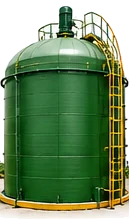
Continuous stirred-tank reactor at ~35°C. Wants a pumpable wet slurry (TS ≤ 12%).
TAKES FEEDSTOCK OR SLURRY · MAKES RAW BIOGAS + DIGESTATE
- Organic loading rate · warn above
- 4 kg VS/m³/day
- Organic loading rate · refuse above
- 5 kg VS/m³/day
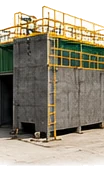
Dry-fermentation plug-flow reactor at ~38°C. Designed for stackable, high-solids feed (TS ≥ 20%).
TAKES FEEDSTOCK OR SLURRY · MAKES RAW BIOGAS + DIGESTATE
- Organic loading rate · warn above
- 6 kg VS/m³/day
- Organic loading rate · refuse above
- 8 kg VS/m³/day
Sourcing sits beside these blocks as it is verified — vendors, capacities and indicative lead times, kept separate from the modelled figures and labelled whenever a link is paid. Supply this equipment?
Answers come from this site's reviewed question bank and cite the entry they came from. Press / to focus. Not investment advice.