Facility
What happens inside?The biology, the vessel and the routine. A digester is a culture of microbes with a loading limit, not a tank that converts tonnes to gas on demand.
Anaerobic digestion
9The biology the whole plant rests on — the four stages, the operating window, and what tips it over.
What is biogas?sourced
Biogas is the gas produced when microbes break down organic matter without oxygen, a process called anaerobic digestion. It is mainly methane and carbon dioxide, with traces of hydrogen sulphide and water vapour. Raw biogas typically contains 50-70% methane.
What is raw biogas?sourced
Raw biogas is the untreated gas straight from the digester - roughly 50-70% methane and 30-45% carbon dioxide, plus trace hydrogen sulphide and water vapour. It must be cleaned and upgraded before it can be sold as CBG.
What is methane?sourced
Methane (CH4) is the energy-carrying, combustible part of biogas, and the same molecule that makes up most of natural gas. The more methane a gas contains, the higher its fuel value.
What is anaerobic digestion?sourced
It is the natural, oxygen-free breakdown of organic matter by microbes, producing biogas and a nutrient-rich residue called digestate. It happens inside a sealed tank called a digester.
What is the C:N ratio?sourced
The carbon-to-nitrogen ratio compares how much carbon a feedstock carries relative to nitrogen, and it controls how well the microbes work. The generally accepted optimum for anaerobic digestion is about 20:1 to 30:1. Too much carbon and the culture runs slow; too much nitrogen and it poisons itself with ammonia.
How much energy is in a cubic metre of biogas?sourced
Raw biogas at 55-65% methane carries about 20-23 MJ per cubic metre, because only the methane fraction holds energy. Pure methane is about 35.8 MJ per cubic metre, and one cubic metre of biogas is roughly equivalent to 0.5-0.6 litres of diesel.
Why does raising the methane percentage raise the energy value?derived
Carbon dioxide, nitrogen and water vapour in biogas are inert and carry no combustion energy, so calorific value scales almost linearly with methane content. Upgrading from about 60% to over 90% methane concentrates the energy per cubic metre, which is what makes CBG saleable as a vehicle fuel rather than a boiler gas.
What is an inoculum, and why does a new digester need one?derived
An inoculum is a starter culture of active anaerobic microbes, usually digestate or slurry from a running digester, or cattle dung. Without seeding, a new digester can take months to establish stable methanogenesis, so the inoculum is what shortens the start-up lag.
What is foaming in a digester, and why does it matter?derived
Foaming is a stable layer of gas-filled bubbles on the digester surface, usually triggered by overloading, or by feed rich in surfactants, proteins or fats. It can block gas offtake, carry slurry into the gas lines and force an unplanned shutdown.
Building a plant
3Land, approvals, PESO, the DPR, and what actually sits on the critical path.
How do you set up a biogas or CBG plant in India?sourced
Secure a reliable feedstock supply first, then pick a site with land, water and a way to move gas out; choose digester and upgrading technology; get an offtake letter of intent from an OMC or a GAIL synchronisation agreement; clear the pollution board, PESO, factory and land approvals; then build and commission. Feedstock security is the make-or-break step, and it comes before the site, not after it.
What are the first steps, concretely?sourced
Confirm feedstock availability with a long supply horizon, identify a site - typically 5-10 acres for a 5-10 TPD plant - and engage an oil marketing company with an Expression of Interest to secure a Letter of Intent. The LOI from IOCL, BPCL, HPCL, GAIL or IGL is the gateway to bankability.
Which pollution-control category does a CBG plant fall under?sourced
Pollution control boards generally categorise CBG plants as White - the least polluting class - which simplifies Consent to Establish and Consent to Operate. Typical CBG scales also avoid full Environmental Clearance under the EIA notification. PESO remains the safety-critical approval regardless.
Operations
3Running it: uptime, parasitic load, maintenance, and the failure modes that idle a plant.
How efficient are biogas plants?sourced
Efficiency depends far more on feedstock and operation than on technology, and many Indian plants run below design capacity mainly because of feedstock supply. Real output is a fraction of the lab BMP potential, so a plant quoted at its BMP is quoted at a number it will never see.
What does a plant operator do in a typical day?derived
Feed the digester to schedule, check temperature, pH and gas quality, log flows and pressures, and inspect the scrubbers, compressors and safety systems. Consistent daily logging is what lets a problem be caught as a trend rather than as a shutdown.
How is raw biogas volume converted to kg of CBG?sourced
A 5 TPD-class plant making about 12,000 cubic metres a day of raw biogas at 60% methane holds roughly 7,200 cubic metres of methane, which after upgrading and compression yields about 4,800-5,000 kg a day of saleable CBG. Volume falls through upgrading because CO2 and H2S are removed; energy density rises.
The blocks
Full catalogue, all figures ->2 of the pieces you can put on the canvas belong to this stage. Every figure behind them is the one the simulator runs on, and each card says what the block takes in and what it hands on.
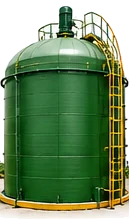
Continuous stirred-tank reactor at ~35°C. Wants a pumpable wet slurry (TS ≤ 12%).
TAKES FEEDSTOCK OR SLURRY · MAKES RAW BIOGAS + DIGESTATE
- Organic loading rate · warn above
- 4 kg VS/m³/day
- Organic loading rate · refuse above
- 5 kg VS/m³/day
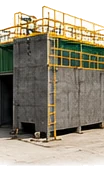
Dry-fermentation plug-flow reactor at ~38°C. Designed for stackable, high-solids feed (TS ≥ 20%).
TAKES FEEDSTOCK OR SLURRY · MAKES RAW BIOGAS + DIGESTATE
- Organic loading rate · warn above
- 6 kg VS/m³/day
- Organic loading rate · refuse above
- 8 kg VS/m³/day
Sourcing sits beside these blocks as it is verified — vendors, capacities and indicative lead times, kept separate from the modelled figures and labelled whenever a link is paid. Supply this equipment?
Answers come from this site's reviewed question bank and cite the entry they came from. Press / to focus. Not investment advice.