Facility
What happens inside?The biology, the vessel and the routine. A digester is a culture of microbes with a loading limit, not a tank that converts tonnes to gas on demand.
Anaerobic digestion
4The biology the whole plant rests on — the four stages, the operating window, and what tips it over.
Why does the C:N ratio matter to an investor?derived
It drives both biogas yield and digester stability, so it decides how much sellable gas a feedstock mix produces and how often the plant trips. High-carbon feedstocks such as paddy straw are usually co-digested with high-nitrogen dung to reach the 20-30:1 window - and that is a procurement commitment, not a setting on a control panel.
What single biological failure most often destroys plant economics?derived
Acidification from overloading or a C:N imbalance, which stalls methanogenesis and cuts gas output for weeks. Conservative loading and co-digestion are cheap insurance against a failure whose recovery time is measured in lost revenue.
Why should investors treat methane's global warming potential as a two-edged number?sourced
Methane's GWP is about 28-30 over 100 years and around 80 over 20 years, so avoided methane is the core climate value of CBG. The same potency means on-site leakage sharply erodes the net benefit, which is why diligence should require leak detection and a specified maximum methane slip rather than taking the carbon claim on trust.
What is degassing of digestate, and why does it matter to the carbon case?sourced
Fresh digestate leaving the main digester still holds residual biogas potential. Stored open, it emits methane and undermines the emissions balance; a covered post-digestion tank captures that residual gas, adding yield and protecting the carbon claim at the same time.
Building a plant
2Land, approvals, PESO, the DPR, and what actually sits on the critical path.
What capex per TPD should a developer budget?sourced
Benchmarks vary by feedstock and offtake model. A 5 TPD plant commonly clusters around 20-30 crore rupees, or roughly 2-3 crore per TPD; the Standing Committee on Petroleum and Natural Gas cited 25-80 crore for a 100 TPD multi-feed plant; and GOBARdhan (2026) offers capital assistance up to 2 crore rupees per TPD against that.
How long does it take from LOI to commissioning, and should you use an EPC?sourced
Approvals processing alone runs about 60-90 days with complete documentation, but the full LOI-to-commissioning path typically takes one to two years once land, feedstock contracting and construction are counted; incomplete paperwork is the most common delay. An EPC route transfers execution and performance risk to a vendor through guarantees and suits first-time developers; self-build can cost less for experienced ones. Either way, insist on performance guarantees tied to realistic feedstock.
Operations
3Running it: uptime, parasitic load, maintenance, and the failure modes that idle a plant.
What is a realistic rupees-per-kg cost walk?sourced
Operating cost stacks feedstock, parasitic power - compression alone at 0.15-0.20 kWh per kg plus upgrading - water and chemicals, media and membrane replacement, labour and maintenance; feedstock and power dominate. Operating cost is often discussed in the 15-22 rupees per kg range, and 85-90% utilisation is what keeps unit cost inside the administered price.
What capacity utilisation is realistic?sourced
Sector data show commissioned capacity far below target and many plants under-running on feedstock, so a conservative model should not assume nameplate output. Model the utilisation the supply calendar supports, and treat nameplate as the ceiling it is.
How should actual performance be benchmarked against design?sourced
Compare achieved methane yield, recovery, specific power consumption and uptime against the DPR and the vendor guarantee values, and investigate persistent gaps against feedstock quality, temperature and slip. Benchmarking is how a plant defends its IRR and how it enforces a performance guarantee.
The blocks
Full catalogue, all figures ->2 of the pieces you can put on the canvas belong to this stage. Every figure behind them is the one the simulator runs on, and each card says what the block takes in and what it hands on.
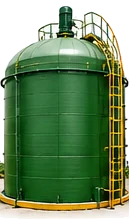
Continuous stirred-tank reactor at ~35°C. Wants a pumpable wet slurry (TS ≤ 12%).
TAKES FEEDSTOCK OR SLURRY · MAKES RAW BIOGAS + DIGESTATE
- Organic loading rate · warn above
- 4 kg VS/m³/day
- Organic loading rate · refuse above
- 5 kg VS/m³/day
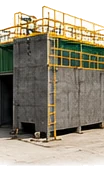
Dry-fermentation plug-flow reactor at ~38°C. Designed for stackable, high-solids feed (TS ≥ 20%).
TAKES FEEDSTOCK OR SLURRY · MAKES RAW BIOGAS + DIGESTATE
- Organic loading rate · warn above
- 6 kg VS/m³/day
- Organic loading rate · refuse above
- 8 kg VS/m³/day
Sourcing sits beside these blocks as it is verified — vendors, capacities and indicative lead times, kept separate from the modelled figures and labelled whenever a link is paid. Supply this equipment?
Answers come from this site's reviewed question bank and cite the entry they came from. Press / to focus. Not investment advice.