Feedstock
What goes in?Everything upstream of the digester inlet. This is where plant economics are won or lost: yield per tonne is a lab number, and what reaches the gate every day is the real one.
Feedstock
8What you feed it, what that yields, and why securing supply — not choosing a digester — is where most plants fail.
What is feedstock?sourced
Feedstock is the organic raw material fed into a biogas plant - cattle dung, crop residues, press mud, food and municipal organic waste, and energy grasses. Its type and quality decide how much gas the plant makes, and its reliability decides whether the plant runs at all.
What is paddy (rice straw) feedstock?sourced
Paddy straw is the stalk left after the rice harvest - abundant across India and often burned, which is a major air-pollution source. It is fibrous and lignocellulosic, so it digests slowly and usually needs size reduction and co-digestion with a nitrogen-rich feed.
What is press mud, and why do sugar mills favour it?sourced
Press mud, or filter cake, is the residue left after sugarcane juice is clarified. It yields roughly 140-160 cubic metres of biogas per tonne and, crucially, arrives in bulk at a single site - which removes the aggregation problem that starves plants running on scattered residues.
Can Napier grass be used to make biogas?sourced
Yes. Napier, or elephant grass, is a fast-growing energy crop that gives methane-rich biogas - about 63.5% methane as a mono-substrate in one study. It is lignocellulosic, so pretreatment and co-digestion improve yield, and it is water-hungry despite its drought tolerance.
How does the feedstock source affect CBG output?sourced
Different feedstocks carry very different volatile-solids content and biogas yield per tonne, so the same plant produces very different gas volumes depending on what is fed. Wet, energy-dense feedstocks such as press mud, food waste and energy grass yield more per tonne than dry dung.
How much biogas does cattle dung yield?sourced
Cattle dung is a stable but modest feedstock, giving roughly 100-140 cubic metres of biogas per tonne, or about 0.20-0.30 cubic metres per kg VS. Much of its energy was already extracted by the animal, so its value is process stability and a nutrient-rich digestate rather than peak yield.
Why is poultry litter both attractive and risky?sourced
Poultry litter is high in nitrogen and protein, giving relatively high gas yield per tonne - often cited above 60-100 cubic metres. But its C:N ratio of around 10-12:1 makes ammonia inhibition a live risk, so it is normally co-digested with a carbon-rich substrate such as dung or straw.
Can food waste and the organic fraction of municipal waste be used?sourced
Yes - segregated food waste and the organic fraction of MSW yield roughly 120-140 cubic metres per tonne, and using them solves a disposal problem at the same time. The hard part is contamination: plastics and grit demand robust pre-sorting, and they push project cost up sharply.
Pretreatment & handling
4Chopping, grinding, ensiling and storing: everything that happens between the field and the digester inlet.
What is a hammer mill?sourced
A hammer mill shreds and grinds biomass with rapidly spinning hammers, cutting particle size so microbes can attack more surface area. It is a common first step for fibrous feedstocks such as straw, and it draws real power - on the order of 25 kWh per tonne.
Why does feedstock need chopping or shredding?sourced
Smaller particles digest faster and more completely because enzymes can reach more surface. Choppers, shredders and hammer mills do that size reduction, and for lignocellulosic feed it is the difference between a digester that keeps up and one that silts up.
What does pretreatment actually do to feedstock?sourced
Pretreatment reduces particle size and disrupts lignocellulosic structure, exposing more surface to microbes and raising both the rate and the extent of digestion. For fibrous crops such as Napier or straw it is essential, because untreated lignocellulose resists microbial hydrolysis.
Why does raw biogas need cleaning before it is useful?sourced
Raw biogas carries CO2, water vapour and corrosive, toxic hydrogen sulphide. H2S and moisture must go to protect engines, compressors and pipelines; CO2 is removed to raise energy density. Cleaning is the difference between a corrosive raw gas and a saleable fuel.
The blocks
Full catalogue, all figures ->12 of the pieces you can put on the canvas belong to this stage. Every figure behind them is the one the simulator runs on, and each card says what the block takes in and what it hands on.
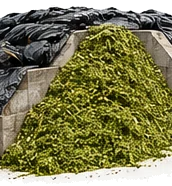
Napier silage
year-roundDedicated elephant grass silage. Balanced C:N and reliable BMP.
SOURCE · MAKES FEEDSTOCK
- Total solids
- 25%
- Volatile solids, of total solids
- 90%
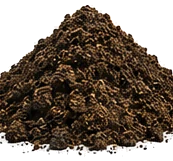
Sugar mill pressmud
seasonalFilter cake from sugar mill juice clarification. Dense, wet, cheap.
SOURCE · MAKES FEEDSTOCK
- Total solids
- 30%
- Volatile solids, of total solids
- 75%
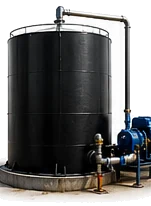
Molasses
year-roundSugar refining residual syrup. Very high BMP and digestibility.
SOURCE · MAKES FEEDSTOCK
- Total solids
- 80%
- Volatile solids, of total solids
- 85%
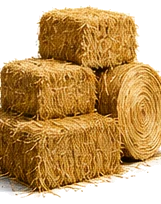
Paddy straw
seasonalRice harvest residue. Very high TS, wide C:N, slow to digest.
SOURCE · MAKES FEEDSTOCK
- Total solids
- 85%
- Volatile solids, of total solids
- 80%
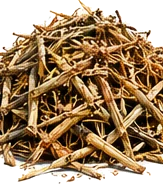
Cane trash
seasonalSugarcane leaves and tops left in the field after harvest.
SOURCE · MAKES FEEDSTOCK
- Total solids
- 70%
- Volatile solids, of total solids
- 85%
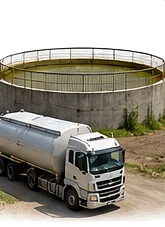
Cattle manure
year-roundDairy or beef cattle slurry. Low TS, low C:N, abundant near dairies.
SOURCE · MAKES FEEDSTOCK
- Total solids
- 12%
- Volatile solids, of total solids
- 80%
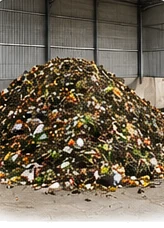
MSW organic fraction
year-roundWet biodegradable fraction of municipal solid waste. Tipping fee eligible.
SOURCE · MAKES FEEDSTOCK
- Total solids
- 30%
- Volatile solids, of total solids
- 75%
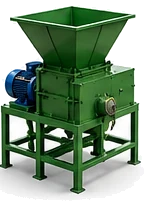
Chops green and soft wet material to a feedable particle size. Enough for napier, trash and segregated wet waste.
TAKES FEEDSTOCK · MAKES FEEDSTOCK
- Specific energy
- 4 kWh/t
- Handling cost
- ₹120/t
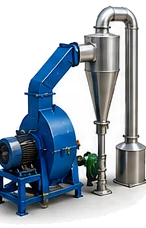
Impact milling for dry lignocellulosic straw. Baled paddy straw cannot be wetted out or pumped until it has been through one.
TAKES FEEDSTOCK · MAKES FEEDSTOCK
- Specific energy
- 25 kWh/t
- Handling cost
- ₹250/t
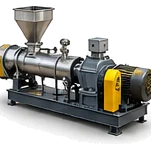
Mechanical pretreatment that shears lignocellulose open. Optional, energy hungry, and its yield uplift is not modelled here.
TAKES FEEDSTOCK · MAKES FEEDSTOCK
- Specific energy
- 45 kWh/t
- Handling cost
- ₹400/t
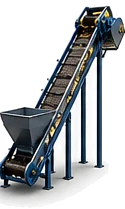
Belts, augers and a feed hopper. Bulk solids do not move themselves, and at plant scale this is a real line item.
TAKES FEEDSTOCK · MAKES FEEDSTOCK
- Specific energy
- 2 kWh/t
- Handling cost
- ₹40/t
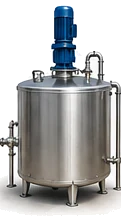
Blends feedstocks, balances C:N, regulates flow into the digester.
TAKES FEEDSTOCK · MAKES SLURRY
- Pre-heat temperature
- 30 °C
Sourcing sits beside these blocks as it is verified — vendors, capacities and indicative lead times, kept separate from the modelled figures and labelled whenever a link is paid. Supply this equipment?
Answers come from this site's reviewed question bank and cite the entry they came from. Press / to focus. Not investment advice.